Skeldritch
Skeldritch is the Boss of the Sand Temple in Spirit Tracks.[2]
Characteristics
Skeldritch's appearance is very similar to that of Stallord; it appears as a large skull with a spine that rises from the center of a large, ruined room filled with Sand, although it lacks arms and a ribcage, and it also sports a large, horned helmet. The skull is also more human-like than Stallord's beast-like skull.
Skeldritch attacks by firing Boulders from its spine at Link, who will need to use the Sand Wand to create walls of Sand that will deflect the attacks. He can then use the Sand Wand to push one of the Boulders into one of the four catapults surrounding Skeldritch, then strike a Shock Switch to fire it back and destroy one of Skeldritch's vertebrae. However, the last three vertebrae are protected by armor, meaning that Link must load a Boulder into a catapult, run around the room to make Skeldritch face a different direction, then fire an Arrow at the Switch to launch the Boulder at Skeldritch's exposed vertebrae. Skeldritch will also shoot a laser from its mouth to try and strike Link whenever possible. When merely the skull remains, it will float around the arena and try to ram into Link. If surrounded by a wall of Sand, Skeldritch will attempt to break out, allowing Link to attack the ruby-like weak point on the back of its skull. Alternately, Link can lift himself up using the Sand Wand any time he is behind Skeldritch to reach the Boss's weak point.
After Skeldritch is defeated, the Sand will drain from the room, revealing a Treasure Chest containing a Heart Container and a stairway to a lower room where Link obtains the Bow of Light.
Trivia
- The "hopping head" phase of the battle strongly resembles the last phase of the fight against Eox in Phantom Hourglass, complete with a vulnerable gem-like object on top of the Boss's head.
Nomenclature
Skeldritch's name is derived from the words "skeleton" and "eldritch", meaning "unearthly", "alien", "supernatural", "weird", "spooky", or "eerie". Skeldritch's name in the PAL version, Capbone, most likely derives from the words cap and bone, as the Boss sports a helmet (cap) and is skeletal in appearance (bone).
 Names in Other Regions Names in Other Regions  | ||
|---|---|---|
| Language | Names | |
| This table was generated using translation pages. To request an addition, please contact a staff member with a reference. | ||
Gallery
-
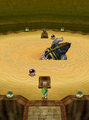
Skeldritch in slumber
-
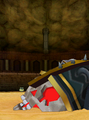
Skeldritch awakens
-
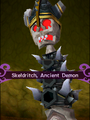
Skeldritch's introduction
-
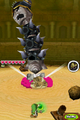
Fighting Skeldritch
-
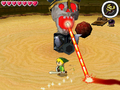
Skeldritch firing a laser at Link
-
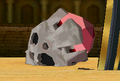
Skeldritch's weak point is exposed
-
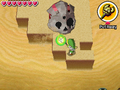
Skeldritch is trapped in Sand with the Sand Wand
-
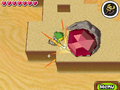
Skeldritch's Critical Point
-
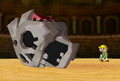
Skeldritch is defeated
-
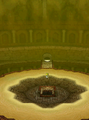
The room where Skeldritch is fought, as it appears after the Boss is defeated


See Also
References
- ↑ "Skeldritch, Ancient Demon" — Game Screen (Spirit Tracks)
- ↑ Encyclopedia, Dark Horse Books, pg. 203


Mazura • Jermafenser • Rebonack • Carock • Gooma • Barba • Thunderbird • Link's Shadow
Ball and Chain Trooper • Armos Knights • Lanmolas • Moldorm • Agahnim
Helmasaur King • Arrghus • Mothula • Blind the Thief • Kholdstare • Vitreous • Trinexx • Ganon
Moldorm • Genie • Slime Eye • Angler Fish • Slime Eel • Facade • Evil Eagle • Hot Head • Shadow Nightmares
Spike Roller • Moblin Chief • Hinox • Dodongo Snakes • Lanmola • Hydrosoar
Master Stalfos • Gohma • Armos Knight • Rover • Grim Creeper • Turtle Rock • Blaino
Gohma • King Dodongo • Barinade • Phantom Ganon • Volvagia • Morpha • Bongo Bongo • Twinrova • Ganon
Lizalfos • Big Octo • Stalfos • Meg • Flare Dancer • White Wolfos • Dark Link • Dead Hand • Gerudo Thief • Iron Knuckle
Odolwa • Goht • Gyorg • Twinmold • Majora's Mask
Dinolfos • Gekko • Wizzrobe • Gerudo Pirate • Wart • Gekko and Mad Jelly
Captain Keeta • Iron Knuckle • Sharp • Igos du Ikana • Garo Master • Gomess • Eyegore
Aquamentus • Dodongo • Mothula • Gohma • Digdogger • Manhandla • Gleeok • Medusa Head • General Onox
Twinrova • Ganon
Brother Goriyas • Facade • Omuai • Agunima • Great Moblin • Syger • Vire • Poe Sisters • Frypolar
Pumpkin Head • Head Thwomp • Shadow Hag • Eyesoar • Smog • Octogon • Possessed Nayru • Plasmarine • Ramrock • Veran
Twinrova • Ganon
Giant Ghini • Swoop • Subterror • Armos Warrior • Great Moblin • Smasher • Vire • Angler Fish • Blue Stalfos
Gohma • Kalle Demos • Gohdan • Helmaroc King • Jalhalla • Molgera • Puppet Ganon • Ganondorf
Mothula • Darknut • Phantom Ganon • Stalfos • Wizzrobe • Mighty Darknut • Big Octo
Phantom Ganon • Stone Arrghus • Helmaroc King • Big Poe • Big Moldorm • Frostare • Vaati • Ganon
Chief Soldier • Shadow Link • Manhandla • Dodongos • Big Dark Stalfos • Gohma • Big Dodongo
Big Green Chuchu • Gleerok • Mazaal • Big Octorok • Gyorg Pair • Vaati
Madderpillar • Dark Nut • Big Blue Chuchu • Red Dark Nut • Black Knight
Diababa • Fyrus • Morpheel • Stallord • Blizzeta • Armogohma • Argorok • Zant • Puppet Zelda • Ganon
Ook • King Bulblin • Dangoro • Twilit Carrier Kargarok • Twilit Bloat
Deku Toad • Death Sword • Darkhammer • Darknut • Aeralfos • Phantom Zant
Stagnox • Fraaz • Phytops • Cragma • Byrne • Skeldritch • Demon Train • Chancellor Cole • Malladus
Mothula • Snapper • Heatoise • Big Blin • Rocktite • Geozard Chief • Dark Link
Ghirahim • Scaldera • Moldarach • The Imprisoned • Koloktos • Tentalus • Levias • Bilocyte • Demise
Stalfos • Lizalfos • Stalmaster • Moldarach • LD-002G Scervo • Dark Lizalfos • Magmanos • Moldorm • LD-003D Dreadfuse
Yuga • Moldorm • Margomill • Gemesaur King • Arrghus • Knucklemaster • Stalblind • Zaganaga • Dharkstare • Grinexx • Yuga Ganon
Armos • Red Stalfos • Heedles • Green & Red Goriyas • Gigabari • Gibdos & Purple Mini-Moldorms • Red Eyegores • Flying Tiles & Devalants • Big Pengator & Pengators • Fire Gimos • Moldorm • Lorule Ball and Chain Soldier • Arrghus
Margoma • Arrghus • Moldorm • Blizzagia • The Lady's Pets • Stalchampion • Prismantus • The Lady • Shadow Links
Electric Blob King • Electric Blob Queen • Hinox Brothers • Freezlord • Vulture Vizier • Grim Repoe • Gigaleon
Windblight Ganon • Fireblight Ganon • Thunderblight Ganon • Waterblight Ganon • Monk Maz Koshia(TCB) • Calamity Ganon • Dark Beast Ganon
Stone Talus • Stone Talus (Luminous) • Stone Talus (Rare) • Igneo Talus • Frost Talus • Igneo Talus Titan(TCB) • Molduga • Molduking(TCB) • Hinox • Blue Hinox • Black Hinox • Master Kohga
Bosses in Tears of the Kingdom
Colgera • Yunobo • Moragia • Marbled Gohma • Sludge Like • Mucktorok • Queen Gibdo • Seized Construct • Phantom Ganon • Demon King's Army • Demon King Ganondorf • Demon Dragon